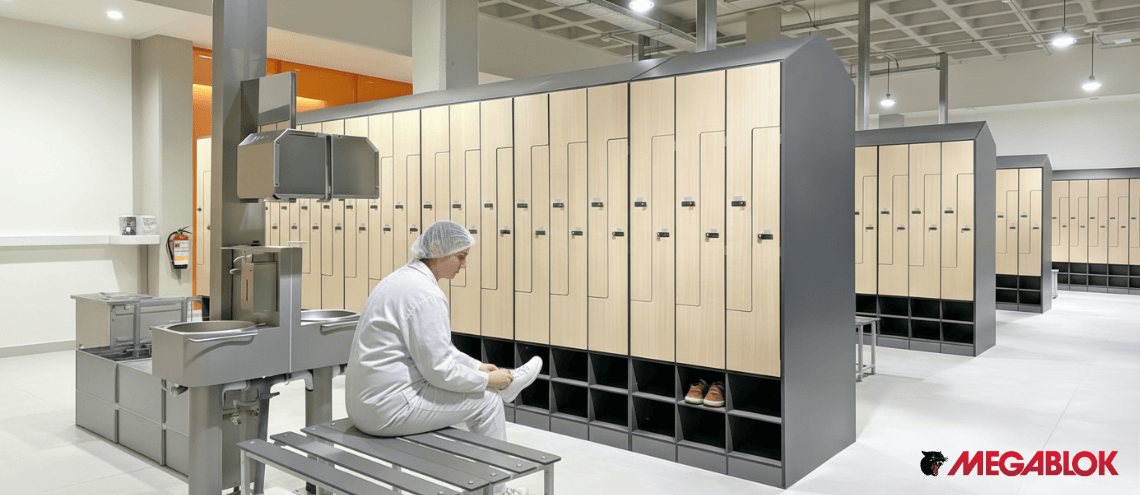
In the food sector there are no “minor details”: a minimum deviation in hygiene, order or safety can end inloss of customers, termination of agreements or major reputational damage. However, many companies still consider the wardrobe a secondary area. The result is that when an audit arrives or an impact appears,the wardrobesuddenly becomes a protagonist: it can bea value asset that provides peace of mind if well-thought, or a focus of risk and unforeseen expenses if not.
InMegablokWe are the leading manufacturers of equipment for sectors with very demanding environments, such as the agro-food industry, where the hygiene, order and resistance of materials are critical.
What is the ROI (defensive) of a wardrobe and how to optimize it?
The concept of defensive ROI refers to the profitability of investments aimed atprotect assets, avoid losses or reduce risks, beyond generating revenue directly. And in this regard, Megablok’s equipment is fully aligned with this task as it favours:
1) Less maintenance time and less spare parts
Even today in some food companies, “standard equipment” is thought to work… until it stops.Smoke, steam, intensive cleaning and chemicals end up passing bill: failed hinges, damaged surfaces, corrosion, parts that are changed by parts and, in the end, complete renovations before time. What seemed like an initial saving becomes a constant drip andthe cost is fired.
The purchase decision that is guided by the price without visualizing other crucial factorsHe makes a serious mistake.
Megablok’s equipment(phenolic and stainless steel lockers)is designed to withstand the real operation of the sector: intensive use, demanding environments and frequent hygienization routines. The return is measurable by two ways:
- Operational savings (OPEX):
Decreased hours of operational cleaning
- Avoided investment (CAPEX):
Onelonger service lifereduces premature repositions. In simple terms: less money spent twice.
The key question for shopping is obvious: what is best, pay less today but have to replace before, or invest better andstretch the life cycle with a quality product?
Or in other words,?what is more cost-effective, an Z cost and life equipment, or a 2Y cost and 4Z service life equipment?
2) Protection against cross-pollution
InFood sector, the wardrobe is the antecedent of production and, if not well-thought,becomes a blind spot: blends between street and working clothes, uncontrolled footwear, accumulated humidity or difficult to clean areas.
A wardrobe with solutions designed to:
Separate street and work clothes as well as footwear
All this acts as astrong preventive barrier. Making afootball comparison, a great defensive mediocentro is not going to go out in the party summaries or put many goals through the squadron, but the day it’s not in the field,The whole team is falling apart.
3) More agile and less non-conformities audits
In the food industry, regulatory compliance is not an option: it is a guarantee of safety, control and survival.
Each non-conformity carries a real costeither because of the need for:
– Total or partial product substitutions – Time and concerns – Reports, photos, corrective actions, verifications in subsequent audits
A properly conditioned wardrobe reduces the risk of non-conformities, resulting in less observations, less reactive tasks andless time of quality and maintenance equipment dedicated to “fire out.”
With the changing solutions for the Megablok food sector (under UNE standards), companies getfacilities aligned with the regulations from the first dayas Royal Decree 486 / 1997 on the minimum requirements ofsafety and health at work.
4) Better image to customers and a more responsible template
A clean, orderly and professional wardrobe says a lot about the companyat external and internal levels. This means that it affects not only the image that customers or external agents who visit the company can take, but for the employees themselves, by:
Strengthening compliance with protocols
For there is a simple reality: a clean and orderly space invites to do things well;One careless normalizes the “everything doesn’t matter.”
In Megablok we do not “make lockers,” but we create awork space working for food companies, maximising hygiene and order, avoiding unnecessary costs and providing a quality image to companies that continue to grow and take care of all the details, as is the case with oursuccesswithGrupo Jorge, Helados Alacant o Mercadonaamong others.
Ask for more uncompromising information for your food company.