Office architecture projects have evolved towards a model where technology, flexibility, and user well-being are the true protagonists.
The rise of hybrid work, hot desking, and shared spaces has completely redefined how work environments are designed and managed. It is no longer about creating fixed workstations, but about designing dynamic environments capable of adapting to different ways of working.
In this context, Megablok’s solutions become a key tool for architects looking to design spaces that meet the new needs of users in modern workplaces.
The current challenge: flexible, functional, and people-centered offices
One of the main issues in today’s offices is the lack of space optimization. It is common to find:
- Overcrowded areas at certain times
- Underutilized spaces the rest of the time
- Lack of order in shared areas
- No data on actual space usage
Without information, there is no improvement. Without technology, there is no efficiency.
That’s why workspace optimization and digitalization are no longer optional—they are essential for better resource management, improved user experience, and reduced daily friction.
But there is something even more important: when a space works well, people feel better. And that directly impacts productivity, satisfaction, and brand perception.
Megablok Open Spaces: optimized workspace management
Within this new paradigm, Megablok Open Spaces equipment offers a practical, simple, and highly effective solution for managing flexible offices.
Through a web-based platform (no app required), users can:
- Book their workspace before arriving at the office
- Ensure they have a place to work
- Manage their belongings conveniently
This system perfectly fits models like hot desking, where workstations are not permanently assigned.
Key advantages for companies and architects
- Space optimization: aligns real usage with demand
- Traceability: data on occupancy and user behavior
- Flexibility: adapts to organizational changes
- Improved user experience
For architects, this means designing spaces that are not only visually appealing but also truly functional.
Community Locker: smart lockers for flexible offices
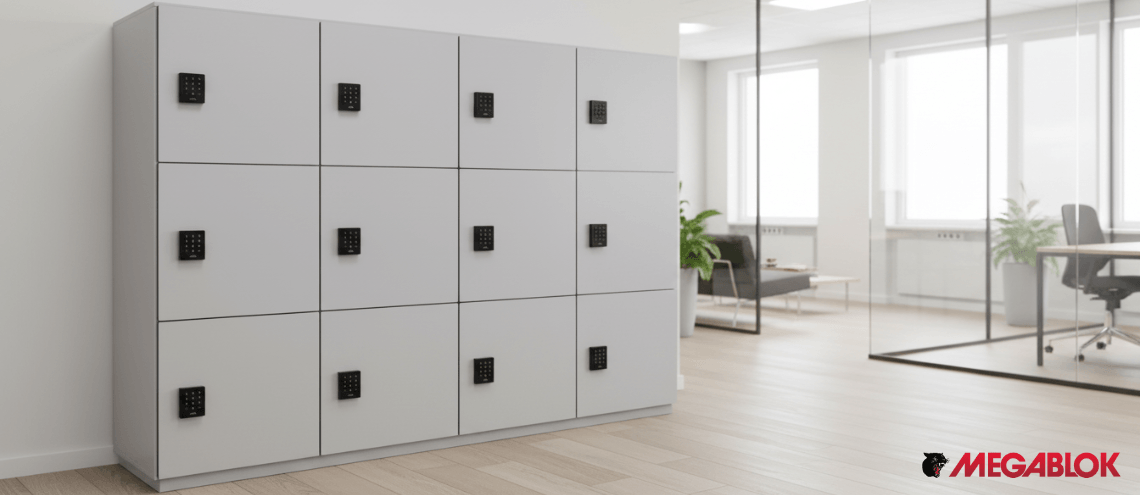
A fundamental element in the hybrid office is the smart locker—and this is where Community Locker, Megablok’s technological solution, stands out.
In environments where no one has a fixed desk, a clear need arises: secure and flexible storage for personal belongings.
What do smart lockers provide?
- Temporary locker assignment
- Digital access
- Automated management
- Greater organization in shared spaces
But their value goes far beyond storage. They also allow:
- Receiving personal or corporate deliveries
- Managing internal materials
- Reducing workplace interruptions
- Optimizing workflows
All of this results in a more organized, efficient, and user-friendly environment.
Technological integration: the new standard in architecture projects
Modern offices are no longer isolated spaces—they are connected ecosystems where every element contributes to the overall performance of the building.
In this sense, Megablok solutions:
- Integrate with access control systems
- Generate data on usage and occupancy
- Enable data-driven decision-making
For architects, this represents a shift in mindset: they are no longer just designing physical spaces, but intelligent and connected environments.
Sustainability: a fundamental pillar
Sustainability is another key pillar in modern architecture—and it goes beyond materials to include efficient use of space.
Megablok solutions help to:
- Optimize resources
- Reduce operational impact
- Implement durable, low-energy solutions
A well-managed space is not only more efficient—it is also more sustainable.
Megablok: a strategic decision for innovative architecture projects
Office architecture is evolving towards smarter, more flexible, and more human-centered models. In this new landscape, Megablok solutions act as a gateway to this new way of designing spaces: more innovative, more sustainable, and more aligned with real needs.
Because today, designing is no longer just about building—it’s about understanding how people work and interact, and creating spaces capable of evolving with them.
Designing offices today means understanding the present and anticipating the future.