Today we are going to talk about a series of doubts and questions that arise when getting to know and experiencing, in situ, the rotating shifts to which healthcare professionals are exposed in our hospitals and health centers. And how, despite the limited space available, they manage to organize the locker rooms of health centers for all available staff.
What are they and why are there rotating shifts?
Rotational shifts are a form of work organized in workdays in which certain start and end times are established with a variable particularity throughout the days or weeks.
This characteristic of hourly variability implies that the managers, or the administration, must inform each of the employees of possible shift changes sufficiently in advance. This form of rotational work arises from the need of the healthcare system to maintain a staff of healthcare professionals in operation 24 hours a day, 365 days a year.
Benefits and drawbacks of rotating shifts
Benefits of rotating shifts
Although it may seem impossible to many, rotating shifts has some advantages for healthcare workers that often go unnoticed.
- Doctors and nurses are not disadvantaged by always having the same “bad” schedule, since hospitals and health centers must offer a 24-hour service 365 days a year.
- They prevent fatigue or exhaustion due to repetitive performance of the same activity.
- They allow for long days off (usually 3), which many find rewarding.
- The workload is equitable because rotations allow for equal sharing of tasks among colleagues.
Disadvantages of rotating shifts
Well, since not all that glitters is gold, we are now going to tell you the other side of the coin: the disadvantages of rotating shifts for healthcare workers.
- Exhaustion, reduced productivity and absenteeism due to fatigue.
- Possible occurrence of sleep disorders, such as: circadian rhythm disturbance, insomnia, sleepwalking, etc.
- Emotional or anxiety-related disorders.
- Increased number of unforced errors in a job. And even the occurrence of a greater number of cases of occupational accidents due to lack of rest or anxiety.
- Work-life balance problems.
Queremos ofrecerte una información de altísimo valor para profesionales del sector sanitario y biotecnológico, a través de un documento con las conclusiones y retos sanitarios extraídos del I FORO SALUD celebrado en Madrid al que asistió MEGABLOK:
Conclusions and health challenges of the I HEALTH FORUM:
Importance of changing rooms in the healthcare sector
Every day, healthcare personnel are exposed to numerous challenges in their profession, as contact with patients and diseases means they are exposed to all of them. For this reason, appropriate clothing that provides them with protection and avoids possible contamination is a basic requirement for the correct performance of their work.
Sanitary clothing, in conjunction with proper attire, is a basic requirement in all hospitals and healthcare facilities. In addition, these uniforms and equipment must be changed and disinfected frequently and constantly in order to prevent the spread of hazardous agents.
What do the regulations say about changing rooms for healthcare facilities?
In Spain all workspaces are regulated and have their corresponding regulations. We, as manufacturers of locker room furniture, are familiar with them, but I’m sure you are missing some points. According to Royal Decree 486/1997 of April 14, 1997, which establishes the minimum safety and health provisions in the workplace:
- Workplaces shall have changing rooms when workers are required to wear special work clothes and cannot be asked, for reasons of health or decorum, to change in other premises.
- Locker rooms shall be provided with seats and individual lockers or lockable lockers of sufficient capacity for the storage of clothing and footwear. Lockers or lockers for work clothes and street clothes shall be separated when this is necessary due to contamination, dirt or humidity of the work clothes.
- When changing rooms are not necessary, workers should be provided with hangers or lockers to store their clothes.
- If the toilet rooms and changing rooms are separated, communication between them should be easy.
- Workplaces shall have toilets with washbasins, located in the vicinity of work stations, rest areas, changing rooms and toilets, when they are not integrated into the latter.
- The dimensions of the changing rooms, washrooms, as well as the respective seating, lockers, hangers, sinks, showers and toilets, must allow the use of these equipment and facilities without difficulty or inconvenience, taking into account in each case the number of workers who will use them simultaneously.
- The premises, installations and equipment mentioned in the previous section shall be easily accessible, suitable for their use and of constructive characteristics that facilitate their cleaning.
- Changing rooms, toilets and washrooms shall be separate for men and women or shall provide for their separate use.
How to equip small locker rooms for a large work team?
On numerous occasions, we receive inquiries from companies in the healthcare sector regarding how to arrange their locker rooms for a team of nurses and doctors on rotating shifts, if they do not have enough space to install a locker per worker.
At Megablok we take care of finding the best solutions for the locker rooms of companies or organizations. In this case, we are going to explain the best way to make your hospital or health center’s locker room space profitable.
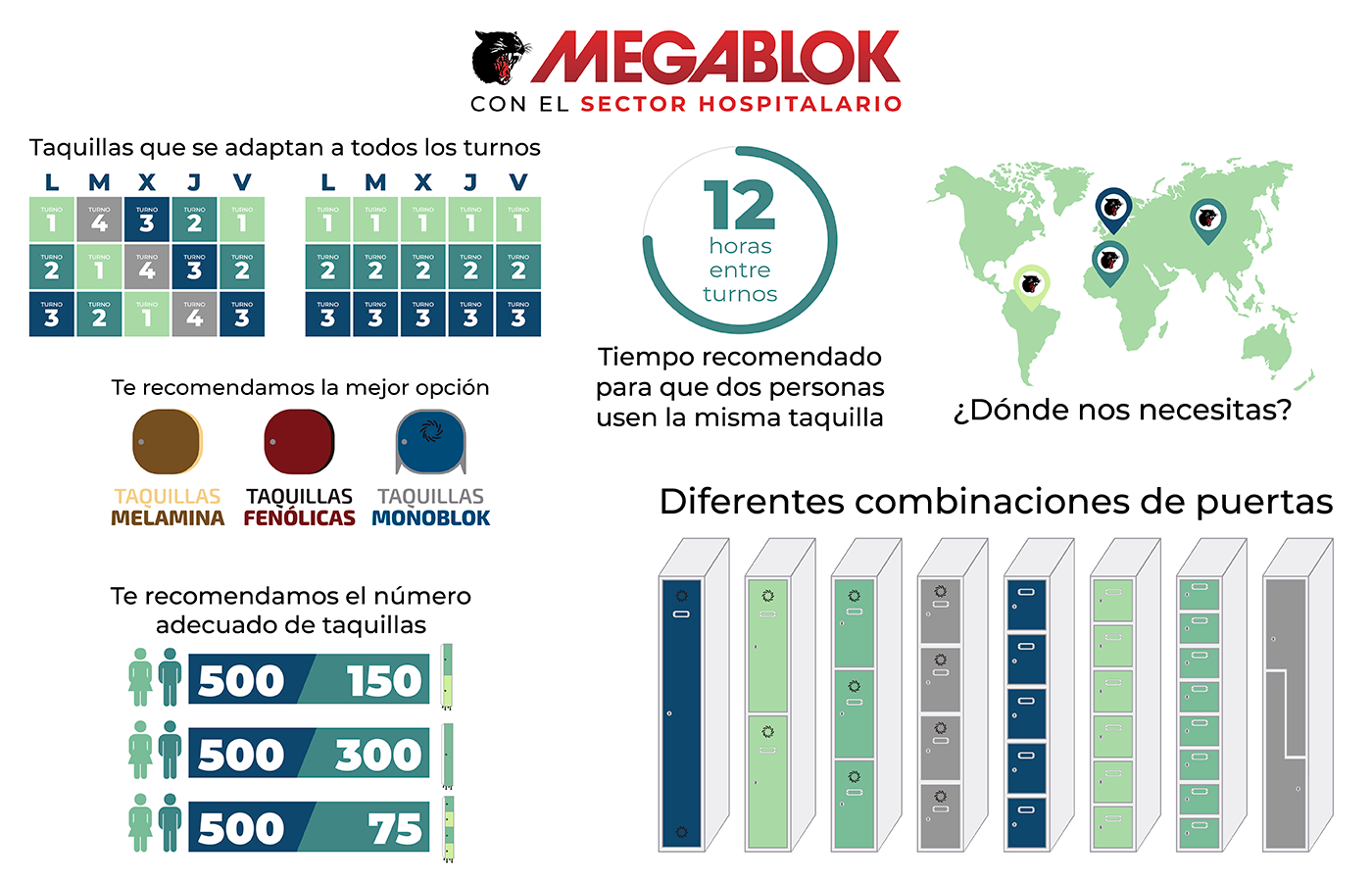
Let’s suppose that the hospital has a staff of 500 workers including doctors, nurses, administrative staff, nursing assistants and cleaning professionals. All of them, by regulation, need a personal locker during their work shift. But do we have to install 500 lockers? We say NO, and we explain why.
It all depends on the number of shifts you have in your medical center. Normally, the shifts of these healthcare workers are divided into 3 or 4. We explain how the rotating locker system would work in both cases:
- Locker exchange for 4 rotating shifts
- Locker exchange for 3 rotating shifts
In both cases we would achieve a 50% reduction in the number of lockers needed. In this way, instead of having 500 lockers distributed in different locker rooms, it will only be necessary to install 250-300 spaces for the storage of personal material and change of clothes.
Our recommendation, in these cases, is for the client to have a number of extra lockers in case a worker leaves the locker occupied, there is an increase in personnel or, as happened during the pandemic, there is an extraordinary increase in personnel.
Locking system for lockers in rotating shifts
We know that sharing the locker of the hospital or medical center where you work can sometimes be annoying (being aware of the keys, sharing a common password, etc.). But, as for everything in this life, don’t worry, there is a solution and we give it to you.
Electronic locks for shared lockers

As we are talking about the use of shared lockers between different healthcare workers, we, as manufacturers, recommend the use of electronic combination locks. These electronic locks allow doctors and nurses to set a private password at the beginning of the day and, when they finish using it, it resets and makes it available for the next worker to create his or her own password.
This lock operates with an alphanumeric keypad interface. For use, users enter a 4-digit, self-selected code. Programming and locker access is achieved through the use of the lock’s keypad combination.
Intelligent lockers for shared use

Smart lockers are the future of the industry. Now, you probably know them for their click and collect system that allows you to pick up your purchases in an easy and simple way, but the reality is that these lockers can go much further.
In the case of lockers in locker rooms for healthcare facilities, our main recommendation goes hand in hand with smart lockers, or Community Locker. But how would this work, and what are the benefits?
With the installation of smart lockers in the locker rooms of your hospital or medical center, you will have control and management capacity of the lockers at all times. In addition, employees will only have to select their name (as a user previously registered in the system), the locker they want among those available and it will open automatically, after entering the desired personal password.
With this shared locker system, not only will you have all the management in the palm of your hand (or on your cell phone), you will also be saving time and money by not having to change the batteries in the electronic locks. And, your environmental impact will be reduced by not having to change batteries at least once a year, because we remind you that an alkaline battery can pollute about 167,000 liters of water.
Materials and form for hospital and health center lockers
Okay, now that we know what is the best way to make the most of the space for your changing rooms and how to save on construction and installation, it is time to talk about the shape and materials suitable for lockers in health centers and hospitals.
The regulations on locker rooms in companies, which are set out in the aforementioned Royal Decree 486/1997, do not specify the construction material that lockers in healthcare centers must have. But, as we are manufacturers, we can give you the best options:
- Metal lockers: if your locker rooms do not have showers and are kept dry, this material can be a good option. Its main features include its high resistance and antibacterial paint, which makes it perfect for sanitary spaces. In addition, these lockers are the most economical option on the market.
- Metal lockers with phenolic doors: we have named these lockers Monoblok PLUS. This model has a greater thickness of the metal enclosure of the locker, so its hardness and resistance are greater. In addition, the phenolic door has waterproof, fireproof and antibacterial characteristics. A locker for all budgets, aesthetic and perfect for hospitals and medical centers.
- Melamine locker: melamine is a material that provides ideal aesthetic characteristics for those healthcare centers that are looking for a certain image. In addition, our melamine lockers have water-repellent properties, which gives them the ability to be in spaces with some humidity.
- Melamine lockers with phenolic door: these lockers, in addition to the aesthetic characteristic mentioned above, having phenolic doors, have a very good resistance to humid spaces, such as locker rooms with showers. In addition, they are also characterized by being fireproof and antibacterial.
Once we have selected the material, it is time to choose the shape we want our locker to have.
For locker rooms where workers need to store personal belongings and clothing, such as toilets, we recommend 3 types of locker arrangement.
- Single-door lockers: with these lockers, personnel will have the full height of the locker (excluding legs or plinth) to store their equipment.
- Lockers with two doors: these lockers have half the available space of the previous ones. But, this will allow you to fit twice as many personnel in the same space … .
- Lockers with L-shaped doors: the shape of these lockers can be the perfect fit for your healthcare locker room. Their L-shape is perfect for medical professionals to hang their gowns and store their slippers. These lockers are only available in metal lockers, monoblock lockers with phenolic doors, melamine lockers with phenolic doors and those made entirely of phenolic.
The correct optimization of the spaces in your changing rooms will allow you to have additional m2 in your hospital or health center and be able to use them for other purposes such as waiting rooms, rooms or rest areas. So do not hesitate and contact experienced manufacturers. Or better yet, contact us.
Solicita información sin compromiso para tu centro sanitario