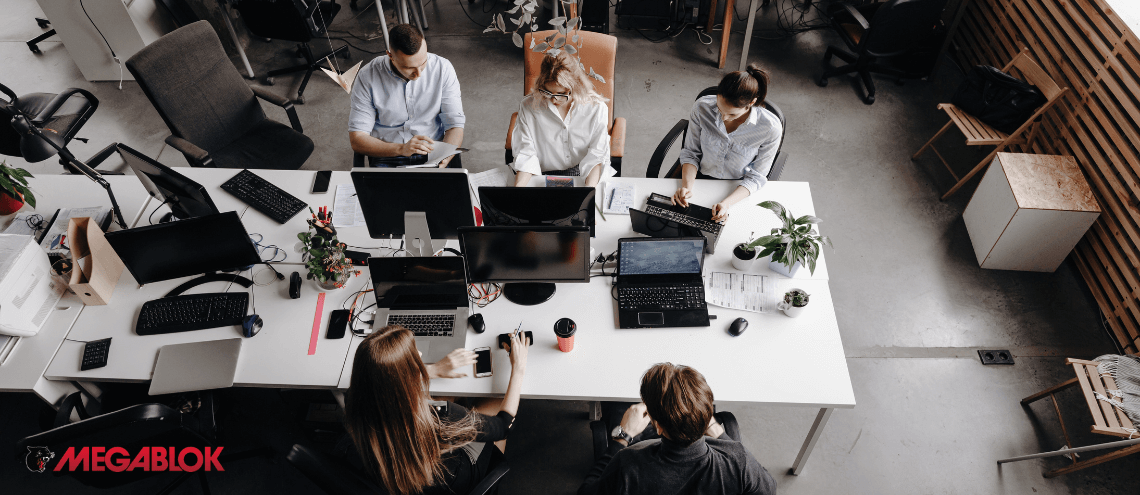
For years, the office was “the place where you work.” Today, with the hybrid model already installed in many organizations, the question is another:What is the office really good for?If the answer is limited to “coming to sit in front of a laptop,” it is normal for many people to prefer to do it from home.
TheEvolving Workplaces studyofISS(the world’s leading company in workplace management and facility management), focuses precisely on this paradigm shift:the office is still relevant, but its value has moved. It no longer competes for being the only possible space to work; it competes for being the space that makes possible what it costs most remote: real collaboration, culture, belonging, creativity… and also concentration when it is well designed.
In Megablok, as leading manufacturers ofoffice furniture, we see this moment as a clear opportunity for companies:modernizing work space is not aesthetic, it is strategy. It is also one of the most tangible levers to improve productivity, well-being and cohesion.
Key data from ISS’s Evolving Workplaces study
The study shows the vision of almost11,000 professionals from 12 sectors and 15 countries (including Spain)to understand how the expectations and use of work space change. Its main points include:
- The office is gaining importance because of what it enables: cohesion, collaboration, creativity, innovation, and a sense of belonging. In Spain, 48% cite social interaction as the main benefit of going to the workplace.
- The value is no longer in the “square meters,” but in the quality of the interactions that the space facilitates.
- In Spain, 71% warn of long-term risks associated with remote work, mentioning impacts on professional relationships and development: four out of ten people indicate that the lack of physical presence harms relationships between colleagues and can slow progress.
- The health aspect also emerges: 24% warn of a possible negative impact on physical or mental health (sedentary lifestyle, isolation, difficulty disconnecting).
- It is emphasized that the balance between in-person and remote work is the most satisfying; specifically, those who work remotely 1–2 days/week show greater satisfaction than those who work remotely 5 days/week, or those who work entirely in person.
- In Spain, 60% say that better facilities and experiences would encourage them to go in more often.
- Globally, 64% say that some factor related to facilities/worker experience would increase their attendance.
5 actions arising from the ISS study
- Plan the long-term hybrid model(flexibility, variable occupancy, adaptable spaces).
- Rethink the office as meeting place (collaboration, socialization, membership; less fixed position, more common spaces).
- Prioritizing experience with quality facilities and technology (ergonomics, concentration, welfare services and “frictionless” technology, including IA).
- Push sustainability and reporting on progress (measures + transparency to strengthen link).
- Listen and decide with data(surveys, satisfaction, space use analysis for iterating design and services)
Conclusions of the ISS study on workplace
The study suggests that“balanced” hybrid models generate greater satisfactionthat the total remote or the presentiality 100%. Why? Because they allow to combine individual flexibility with the benefits of face-to-face interaction.
But the hybrid has a trap: if the office is a broth of home work (put in line, saturated rooms, noise, few focus areas), the experience is degraded. The consequence is predictable: aid falls, internal policies are tightened and the debate becomes “face vs remote,” whenthe real debate is “office with valuevs office worthless. “
The solution is not to force. The solution is to design the office so that people think:
“Here I collaborate better.”
“Here I advance projects faster”
“Here I connect to my team”
“Here I focus when I need it”
“Here I am more comfortable and better care for my health”
That can’t be achieved with a slogan.It is achieved with a workplace adapted to the real needs.
Megablok’s
Role: Furniture as a Productivity Infrastructure.
Modernizing an office isn’t just about “decorating.” It’s about creating spaces for collaboration, concentration, learning, belonging, and work-life balance. And that’s where furniture acts as a 360º infrastructure.
At Megablok, we help companies transform their offices with furniture solutions focused on activity, modularity, ergonomics, and quality: spaces that people want to use because they work.
If your office isn’t helping your team collaborate better than remotely, concentrate without friction, and feel a sense of belonging, it’s not an “attitude” problem. It’s a design problem.
The good news: it can be solved with concrete decisions, starting with the space itself and
how we furnish it. Megablok’s office solutions range from traditional furniture suitable for open spaces to smart solutions like smart lockers. Is your company ready to take the leap and invest in growth?